
The further you travel from the sea, the more Catalonia changes: stone towns, forest trails, waterfalls and the Pyrenees. These are half-day or full-day trips — sometimes as much for the road itself as for the place at the end of it.
A small walled town on the way inland, just twenty minutes from our door. Each spring, around Holy Week, its fortress opens for three days of artisans, processions, and falconry — the Fira Medieval, now nearing its thirtieth year.
At Cim d’Àligues, the most memorable part begins when the birds take to the air. Eagles, falcons, vultures and owls fly remarkably close, quickly changing any idea of this being an ordinary animal show.
The centre is dedicated to birds of prey and explains their behaviour, flight and conservation. Children usually find it fascinating, although adults tend to follow the presentation just as closely.
Check the programme before setting off: the free-flight demonstration is the central part of the visit.
A cathedral town in the heart of an old inland plain, ringed by oak woods. Tuesdays and Saturdays are market days beneath the arcades of Plaça Major — one of the most beautiful squares in Catalonia.
A stone village cut almost literally out of the rock — its name means "carved stone". Tiny, walkable in an hour, but memorable for much longer.
In Besalú, there is no need to search for the perfect opening view — the town begins with one. The old stone bridge over the Fluvià River leads straight into medieval streets, arches and small squares.
Beyond the bridge, it is worth exploring the former Jewish quarter, seeing the medieval mikveh and continuing to the church of Sant Pere. But some of the best moments are found between the main sights — in hidden courtyards, beneath stone arches and along streets chosen simply out of curiosity.
Besalú takes on an entirely different character during the Besalú Medieval festival. At the end of August and beginning of September, the old town returns to the Middle Ages for a few days, with artisan stalls, costumes, music, street performances and scenes of knights in action.
Afterwards, stay for lunch — the stone walls, bridge and river remain part of the view.
A walled Empordà village built around the castle of the Rocabertí family, with a fourteenth-century convent and some of Catalonia's oldest wineries.
In July and August, the castle gardens become one of the country's finest music venues — the Festival Castell de Peralada, with opera, classical music, and dance, returning every summer since 1987. During Holy Week, a smaller cycle of chamber concerts is held inside the Church of Carme.
Rupit seems to be made entirely from stone, cliffs and forest. Beyond the suspension bridge lie narrow streets, old houses and small squares — and just outside the village, the mountain trails begin.
The best-known route leads to the Salt de Sallent waterfall. A longer option passes several waterfalls and Cova Molera; this is no longer a gentle walk, but a proper hike over uneven paths with noticeable changes in elevation.
It is worth setting aside a full day: explore the village first and then follow the trail — or do the hike while there is still plenty of energy left.
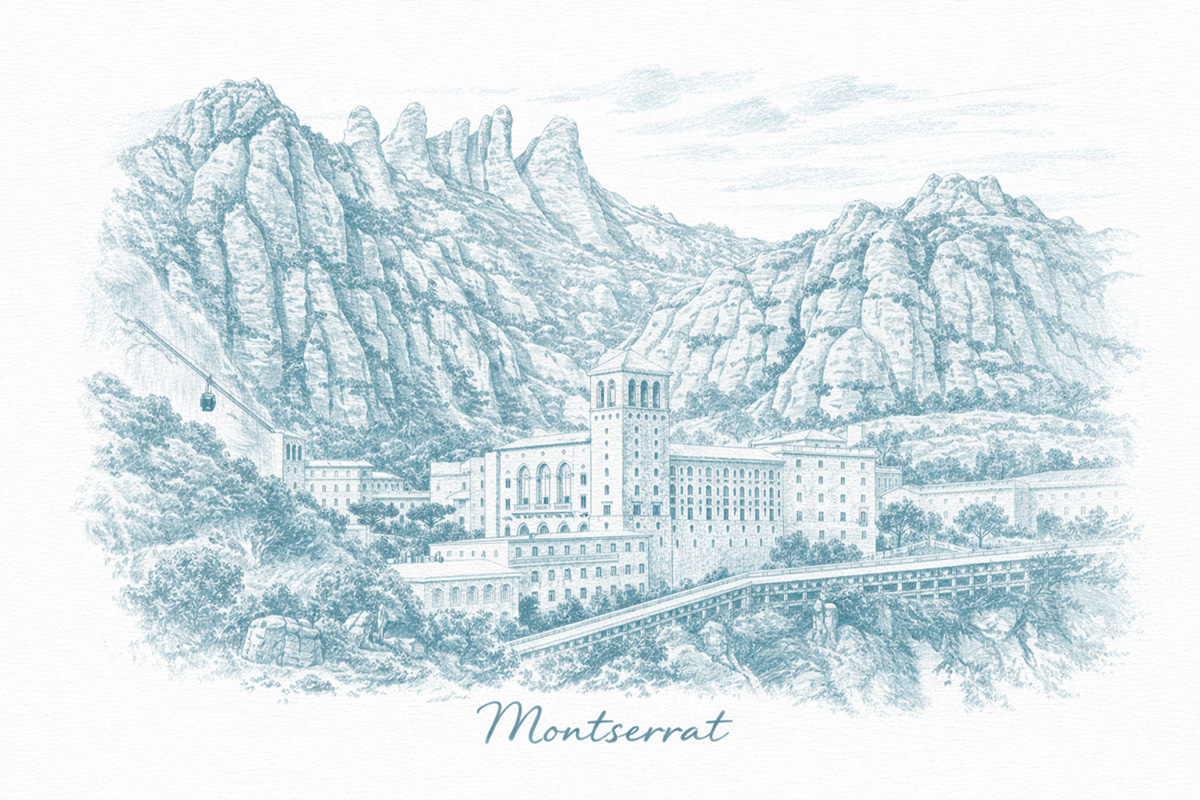
The monastery rises out of a massif of strange, serrated rock — visible from Santa Susanna on a clear day. A day trip worth making for the boys' choir at noon and the cable-car views alone.
Molló Parc is not quite a zoo in the usual sense. It is a long route through the forests and meadows of the Pyrenees, where you can see bears, wolves, lynx, deer, marmots and other animals of the mountain region.
Rather than moving between enclosures along a short path, you walk through the landscape itself — the route is part of the experience. Allow several hours and wear comfortable footwear.
The visit can be combined with Camprodon, Molló or the stone village of Beget for a full day in the Pyrenees.