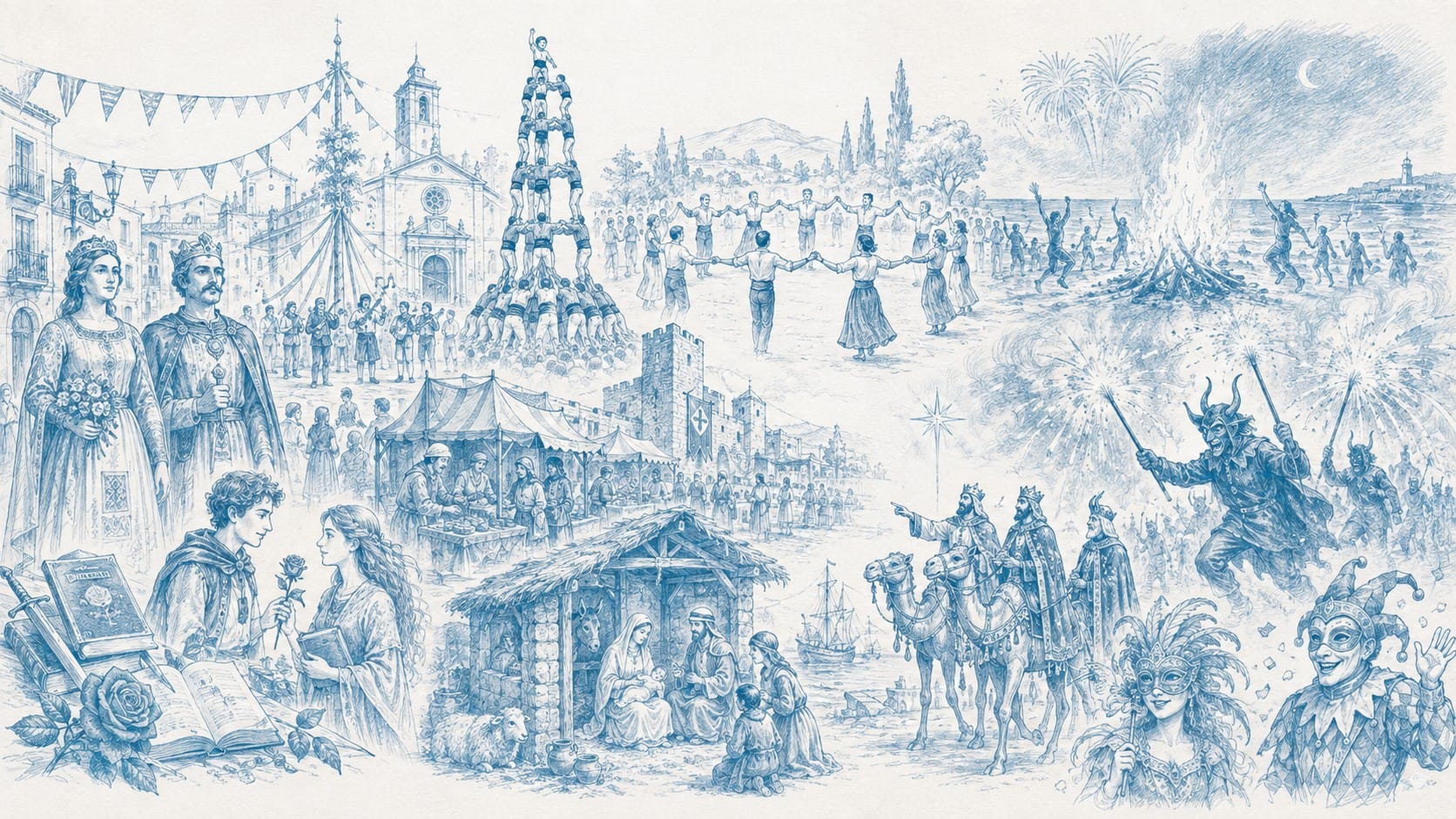

Twelve things worth knowing before you go — not as a checklist, but as a way of arriving with some context.
A Festa Major is the main annual celebration of a town or neighbourhood: a few days when local life turns outward and everything seems to gather in one place — music, parades, children's events, local traditions, dancing, giants, correfocs, fireworks, and long meals in the open air.
It is not a festival staged around visitors, but a moment when a town seems to become more fully itself. If you arrive during a festa major, you are not simply watching something — you are, for a little while, stepping into the town's own rhythm.
A Fira Medieval is a medieval fair: old streets or fortress towns fill with market stalls, craftsmen, music, performers, costumed figures, and echoes of another era. In Catalonia, these events often use the town's real historic setting rather than an invented stage, which is part of their charm.
It is less like visiting a museum and more like watching a town briefly step back into its own past. The atmosphere is lively, theatrical, and a little playful, but what stays with you is often the setting itself — stone streets, old walls, and a sense that the place already knew how to hold this mood.
A Pessebre Vivent is a living nativity scene, usually staged outdoors at Christmas, where local residents recreate the Nativity together with scenes of old village life, crafts, and everyday work. In Catalonia, many towns are known for them, and some involve hundreds of participants.
It is neither ordinary theatre nor simply decoration. It feels more like a temporary world built by the town itself — slower, quieter, more tactile, and often more moving than visitors expect.
Every 23 April, Catalonia celebrates Sant Jordi, one of its most beloved days: streets fill with books and roses, and people exchange them with one another as gifts. The atmosphere is literary, public, festive, and unusually gentle.
It is one of those celebrations that hardly needs explaining once you are inside it. You walk, browse, choose a book, buy a rose, and suddenly the whole city feels slightly softer than usual.
Sant Joan, on the night of 23 June, marks the beginning of summer with bonfires, firecrackers, fireworks, shared dinners, and in many places the symbolic arrival of the Flama del Canigó. Along the coast, it is one of the loudest and most unmistakable nights of the year.
This is not a quiet evening. It is a night of sparks, sound, sea air, and collective release. For some people that is exactly the beauty of it; for others, it simply helps to know in advance what kind of night it will be.
A correfoc is a street fire-run in which performers dressed as devils or fantastical creatures move through the streets with sparks, fireworks, drums, and dancing. It is one of the most recognisable Catalan public traditions, and the public often stands very close to the action.
For first-time visitors it can look dramatic, but locally it is met with surprising ease. It is joyful, noisy, and vividly physical — less something you "watch" from a distance than something that happens in the street around you.
Castells are human towers built by local groups, usually during annual festivities in Catalan towns and cities. The tradition is more than two centuries old, and UNESCO inscribed it on the Representative List of the Intangible Cultural Heritage of Humanity in 2010.
Seen in person, castells are more moving than they first sound on paper. A square grows quiet, music narrows the moment, everyone looks upward — and suddenly what seemed impossible becomes, for a brief instant, perfectly steady.
The sardana is one of the emblematic dances of Catalonia. It is danced in a circle, hand in hand, often in town squares and local festivals, and is accompanied by a cobla, the traditional Catalan wind band. It is often described as a symbol of unity and shared civic life.
Compared with fireworks or parades, the sardana can seem almost quiet. But that is part of its beauty: a circle, a square, a band, and a dance that says a place still knows how to gather itself.
Gegants are giant festival figures, and capgrossos are their big-headed companions. They appear in parades, local festivals, and traditional celebrations across Catalonia, often together with music, drummers, and other festive characters.
For children, they are often the most unforgettable part of a local celebration. For adults, they are a reminder that Catalan traditions are not abstract heritage — they are still carried, danced, greeted, and loved in the street.
The evening of 5 January belongs to Reyes Magos. Across Catalonia, towns welcome the Reyes Magos with floats, music, pages, sweets, and processions, and for many families this is the emotional high point of the Christmas season.
This is not a minor Christmas extra. It is one of those nights when children are completely inside the story, and the whole town agrees, for a few hours, to believe with them.
For a few days, familiar Catalonia becomes noticeably louder — and much less serious.
In February, before Lent, towns put on their carnival parades — rua de Carnaval. Costumes are often prepared by whole groups: music, elaborate sets, dancing, confetti and floats fill the streets well into the evening.
For children, it is one of those celebrations that needs no explanation: a costume and a good spot near the parade are enough. For adults, it is a chance to see just how seriously small towns can prepare for a few hours of completely unserious fun.
Carnival dates change every year, so it is best to check the programme for the town you want to visit closer to your stay.
At the end of October, Catalonia has a tradition of its own — and it smells of roasted chestnuts.
Castanyada is celebrated around 31 October and Tots Sants. Street stalls appear with hot chestnuts and roasted sweet potatoes, while homes and pastry shops fill with panellets — small almond sweets, most often topped with pine nuts.
Halloween has also made its way to Catalonia, especially into schools, children’s parties and shop windows. So pumpkins and costumes now sit quite happily alongside chestnuts and panellets.
But for the local version of these days, we would choose a bag of hot chestnuts and a box of good panellets. Sometimes getting to know a region starts exactly like that.